Sunday, March 12, 2017

Vox ToneLab SE and LE

Top: Vox Tonelab SE in flight case w/lid removed. Bottom: Vox Tonelab LE


As a long time gigging musician in various cover band and original projects, I am always on the lookout for gear that allows me to approximate a range of amp tones and effects in a live setting without carrying an inordinate amount of gear. Multi-FX units seem to be all the rage currently for this purpose among local gigging musicians.

I first encountered the Vox Valvetronix line of gear several years ago, when I did a fill in gig for the second guitarist in a friend's cover band. My friend provided a Vox Valvetronix AD100VT head and 2X12 cabinet as backline for the gig. I was astonished at the remarkable tube-like "sag" and "push-pull" dynamics I was able to achieve with this set up and the impeccable quality and believability of each of the low gain amp models. My experience with (mostly digital) modeling amps prior to the Vox was that higher gain sounds were more believable, and that low and moderate gain vintage tube amp "breaking up" sounds were just not going to be achievable with what was available at that time.

Shortly after that experience, I bought the head I used at that gig and a Marshall 4X12 cabinet to accompany it. I used this for my live rig for a time with great success. Eventually, I sold this rig to get something easier to carry, and purchased a more manageable 160W Fender 2X12 combo to use with a few pedals.

Fast forward to 2016. I was working on a project where I needed a few different vintage tube amp tones: Tweed Fender, Blackface Fender, Vox AC30, Marshall Plexi, and Marshall JCM specifically. Using additional pedals to get all of these sounds proved cumbersome and expensive.

My friend then offered me a mint Vox ToneLab LE he was selling for $200. This seemed like an ideal solution-I already knew I liked the Vox Valvetronix line of gear, and I was already familiar with the basic operation. The LE was full of useful tones, fairly compact, and built like a tank.

I dialed in a patch for each of the amp tones/FX combos I needed, and programmed the control button to engage a solo boost in the form of a tube OD. I also configured the expression pedal for volume. Presto. I had the warm sounds I needed with believable tube "sag" and warmth.

I used this remarkably good sounding unit for several gigs before realizing it lacked a couple of features I really wanted. One feature was a channel A/B switch for each patch, so I could set up a clean or light crunch amp tone on "A" and a more high gain tone on the "B"channel. The second issue was that the single expression pedal meant that I had to choose between Volume and Wah, I didn't have the option with the LE for both.

At this point, fate intervened in the form of a ToneLab SE in a ATA approved flight case listed for sale on Craigslist that turned out to be a mere two blocks away from my house. The SE was the larger road-rugged version of the series and had the channel A/B feature I wanted as well as the extra expression pedal allowing for volume and wah to be used at the same time. The price was a reasonable $250 and I couldn't snap it up fast enough.

I began using the SE for my local and road gigs right away and immediately began to get compliments on my tone at the shows from other guitar players, They were all dumbfounded to discover I was using a ToneLab instead of some high end tube gear to get the sounds they were hearing.

My sounds are very simple.  I use very basic mid gain amp tones with boosted midrange and high mid for presence and cut. I use a smidgen of Analog delay for thickness and classic spring reverb at about 40% "wet" on all of my patches. My usage of other effects is limited to the specific songs that require them-the gobs of that distinctive chorus on "Purple Rain" for example.

The things I love about the ToneLab are as follows:

1. Easy to program and understand because of actual tweakable knobs.
2. Very believable low gain vintage tube amp models with excellent tube-like dynamics
3. Rugged and reliable build quality

One very real downside is that the believability of the amp sounds diminishes noticeably on the higher gain styles of amp model. If you are a metal or hardcore player, this unit is not likely to work for you at all.

If you play any combination of Blues, Rock, Hard Rock, Country-you will very likely find usable and believable sounds in this unit. I know I did.

Sunday, July 17, 2016

Vox Pathfinder 15/15R Review

I am always on the lookout for gear that punches above its weight class and represents good value for money. I've been hearing since around 1999 or 2000 about the inexpensive solid state 15 Watt Vox Pathfinder series amps. The general consensus among end users I've spoken with has been that Vox had created a winner. The actual new selling price of this amp was a remarkably low $120 with on board reverb until the model was discontinued in 2013.

The fact that professional touring musicians like Feist and Holly Golightly use these amps every night on stage certainly gave me the impetus to want to give these amps a look. A few weeks ago, I had the opportunity to trade for a Vox Pathfinder 15 and decided to go for it.

After a few weeks of playing this amp regularly, I have put it through its paces-and have to say I am pleasantly surprised. Starting with appearances, it looks like a classic Vox amp-which to me is a very desirable feature and unexpected on an inexpensive amp.

The operation of the amp itself couldn't be simpler- it is set up like a familiar single channel class A tube amp. You have self explanatory gain and volume controls with a foot switchable volume/gain boost function, a surprisingly useful two band EQ consisting of treble and bass controls, tremolo speed and depth controls and a reverb level knob. (15R)


Simply dial in the amount of gain you desire, set your volume, treble/bass and FX levels and off you go! The boost feature and tremolo can both be foot switched with the optional stereo footswitch. (Sold Separately) The volume is surprisingly loud for a solid state 15W RMS unit-this amp should work fine for rehearsals and small gigs unless you are working with a very hyperactive drummer. The tone is all Vox-clean at low volume then that classic "chingy" chime and more grit as the gain and volume is increased. As with all solid state amps, it does get a bit "grainy" or "fizzy" at ultra high gain levels-so I would not recommend this amp for harder edged musical styles. The tremolo and reverb are useful effects and also unusual to find in this price point.

The tone of this amp is surprisingly good through the stock Vox "Blue Bulldog" speaker. If incredibly tube like dynamic vintage classic rock sounds are your thing, this amp is surprisingly tasty. I find I prefer to engage the boost, set the gain, crank the volume of the amp to the desired level and work the guitar volume knob and vary my pick attack to get more or less break up and volume. For me, engaging the boost for solos didn't work as intended because I found the boost to be substantially louder than the base tone regardless of gain level. The boost feature also got too muddy for my taste when switched on at very high gain levels.

Using the on board 8 ohm extension speaker output to play through a 12" cab opens up the sound of this amp considerably. You also have an on-board line out you can use through the P.A.which is an extremely useful and absolutely unheard of feature in any amp this inexpensive. There is also an on-board headphone jack for quiet practice.

All in all, this is a dynamite sounding and surprisingly versatile little amp that is far more useful than its humble price point would suggest. If you have a use for a grab and go combo as a go to practice, rehearsal or small gig amp, I don't believe you'll regret buying this one. It doesn't just sound good for $120. It sounds good period...and that explains why it has found its way onstage with nationally touring musicians who could use any gear at all-but choose this little marvel..After playing mine, its easy to understand why. If you are considering one of these as you read this, just buy the damned thing already!


Thursday, May 21, 2015

$29.99 Behringer BDI-21 review. (Tech 21 SansAmp Bass Driver DI Clone)

I 'm a working bass player (and guitarist) with River Canyon Band out of Chattanooga. A key tool in many working bass players' arsenal is a solid active direct box to get a balanced line in into the PA with your preferred amp gain and eq settings intact. You connect your bass to the DI box via 1/4" instrument cable, run an XLR cable from the low-z out on the box to the mixing console, and have the option to run a high-z 1/4" out to your on stage amp to use as a monitor. Once set up, you click the foot switch, dial in your tone with the gain, presence, EQ and blend controls...and play. Simple, and effective.

Tech 21 SansAmp Bass Driver
For years, the gold standard has been the Tech 21 Sansamp Bass Driver DI. It gives you a great tube bass amp emulation with adjustable gain/drive, 2 band EQ, presence and a blend knob to blend the simulated tube amp tone with raw tone from your bass pickups. This box does exactly what it is supposed to do and is housed in a very durable metal housing for the reasonable price of $199.00 at www.sweetwater.com With theSans amp, you can get everything from mellow tube amp bass sounds to growling 70's style overdrive and plenty of degrees in between. 

What if you don't have $200? Or maybe you've never used an active DI for bass and you are want to try one out without dropping a pair of Bejamins.On stage I had been trying to use an underpowered (100W) bass combo amp for my gigs-and it wasn't punchy enough. Trying to conect an unbalanced high z 1/4" instrument cable directly to the PA got me a decent recording sound, but wasn't getting me the live punch I was looking for either. I knew I needed something like the SansAmp Active DI/Amp emulator box, but finding the $200 wasn't going to be easy. That's when I heard about the Behringer BDI-21. 

Once I researched the BDI-21 and realized it was a mere $29.99, it was a no brainer to order it from my go to professional music supplier www.sweetwater.com.


I'll make this brief. I wholeheartedly recommend this box. It works exactly like the SansAmp and I couldn't be happier with the nice round warm tones I'm getting through the PA. I can get mellow classic tube amp tones, or crank up some midrange growl and really drive it. Setting up my rig is quick and easy and everything sounds dynamite. The housing doesn't seem quite as durable as the SansAmp-so buying a backup isn't a bad idea. Of course at $29 each, you can get 3 for $100 and have a backup for your backup! 


Sunday, August 31, 2014

User review-JOYO JF-36 Sweet Baby Overdrive

As a working musician on a limited budget, I am always seeking bargains. When it comes to achieving the sounds I am looking for, I like to keep things simple and effective. There is nothing wrong with using a multi-effects unit or a modeling amp with tons of built in effects if the end result gets you the sounds you need and you can operate it with a minimum of hassle. I'm not that guy.

Dialing in multi-effects units and amp simulation algorithms on digital amps to save each setting for recall and balancing the volume between each is a slow and tedious process. I also find that all the time invested seldom gets me exactly the sound I am looking for. On the flip side, having an amp-whether one or more channel dialed in with a usable base tone and putting a few pedals in front of it works great for me. There's just a few knobs to tweak and I can quickly dial my tone in effortlessly.

I'm a "vintage" sound kind of guy. I'm not a purist, or a gear snob because my budget doesn't allow me the luxury. For my Strats and Teles I like the clean sound of an American (Class A/B) tube amp-specifically the mid sixties era "Blackface" amps and their various clones. For blues and blues-rock there is nothing better. The recipe is simple-dial in the clean amp with reverb to taste and use a handful of pedals to get the various sounds you are looking for. For dirty sounds I prefer the British (Class A) amps.


I've been hearing for some time about the Mad Professor Sweet Honey Overdrive. This is a boutique pedal with a $300 price tag that can also be picked up used on sites such as www.reverb.com.This is a low to medium gain overdrive that was billed as offering killer sounds for blues, jazz and country. It seemed as though it would be very useful on my pedalboard. Alas, paying $300 for a hand wired boutique pedal was not in my future. There is also a PCB version-but $150 wasn't happening any time soon either.

I went looking for a clone at www.cheaperpedals.com which is my go to site for bargain effects pedals. Sure enough, JOYO offers a SHO clone called the Sweet Baby Overdrive for a mere $39.00! Before I could order it, fate intervened in the form of a "for sale" listing on the Chattanooga, Cleveland and North Georgia Gear Trader Facebook page. A local musician was offering a slightly used Sweet Baby OD for sale for $10! Needless to say, I jumped on the opportunity!

Upon arriving home, I removed the four screws from the bottom, popped in a fresh 9 volt battery, buttoned it all back up and began to put the pedal through its paces with my vintage style Strat. The controls are very simple. "Volume" and "Drive" are self explanatory. The third knob labeled "Focus" is what sets this pedal apart-and where the real magic happens.

When the "Focus" knob is turned completely counterclockwise, the overdrive is extremely sensitive to your touch. Picking harder results in more overdriven tone. The overall tone is also "softer" with that tube "sag." This couldn't be more perfect for blues and jazz. You can literally "set and forget" this pedal and use your guitar volume knob and pick attack for various levels of overdriven tone the way it used to be done!

As you turn the "Focus" knob clockwise the sound becomes "tighter" and the overdrive effect occurs more readily with less pick attack needed. The tone is noticably "sharper" and and I could see this being very usable for mildly overdriven twangy country sounds. The "Focus" knob also impacts the EQ slightly with a noticeable increase in treble response as the knob is rotated clockwise.

The real beauty of this pedal for me is its transparency. It literally sounds good in front of every kind of amp. There is a bit of a midrange "bump" when the pedal is engaged, but not enough to require readjusting the amp settings. I tweaked the knobs every conceivable way-but I literally could not adjust this pedal to sound bad no matter how hard I tried! I ended up finding lots of usable tones for all sorts of styles.

The bottom line with this one is that you absolutely can't go wrong at $39 for such a versatile pedal! Buy it and love it. If you're worried about the build quality and durability....buy two!

Wednesday, August 27, 2014

Product Review-SX VTG Series Ursa 1 P-Bass Copy

As a working musician with a perpetually limited budget, I am always on the hunt for bargains. I had been hearing for some time about Rondo Music (www.rondomusic.com) SX and Douglas brand basses on the Talk Bass internet forum (www.talkbass.com)-especially the P-Bass, Tele-Bass, and J-Bass copies. I am once again working as a bassist, so I was looking for an inexpensive axe that would be good enough out of the box to start working, but also a good platform for modifications.

As those of you following the blog know, I get a great deal of satisfaction from modifying budget gear to be usable for a working musician. If you do not believe that budget gear can ever be modified to work just as well as gear that is professional grade right off the shelf, then this blog is not for you. My experiences are unlikely to change your mind.

I surfed on over to http://www.rondomusic.com/bassguitars4.html to look at four string basses, and settled on the Ursa 1-which is a P-Bass copy with a Maple neck and fingerboard. http://www.rondomusic.com/ursabkmn.html. The price of $115.00 for a P-Bass clone with an alder body including a gig bag and instructional DVD made me think there was absolutely no way I could lose. Ground shipping to Chattanooga added another $17.28 which brought the total to $132.28. Rondo takes PayPal, which makes ordering a snap.

SX VTG Series Ursa 1 Bass
Upon arrival of the bass, I was struck by the clean, classic P-Bass look. The paint on the body was surprisingly good, with no runs or obvious flaws. The neck was straight with a vintage tone finish and the action not bad for a "new out of box" imported bass. The frets were par for the course -they'll need a little touching up with a file. With any new instrument, you should plan on having a professional set up done with your preferred strings. 


Upon initial inspection, I have to say that the headstock look on these basses is industrial strength ugly IMHO. Perhaps it can be cut to a more pleasing shape. That's definitely a modification I'm going to consider. 

The hideous SX headstoc

The tuners are your typical open gear imported bass tuners. They do the job adequately. I will probably replace these with some vintage style tuners. The nut was the standard plastic variety. It will definitely need to be replaced for maximum tuning stability. The bridge appears to be adequate. As expected, I had to do some subtle intonation adjustments. 

Upon plugging this bass in, I was absolutely stunned. This thing sounds exactly like a P-Bass is supposed to sound. It has a sweet tone and the balance between the strings is surprisingly good. The noise level is exactly what you would expect from an unshielded single coil bass guitar.  I will very likely put a set of flat wound strings on to complete the vintage tone and flavor of this instrument. 

At a price that is nearly 40% below the price of the cheapest Squier P-Bass, I am impressed. The body wood is the best thing about this bass. It is genuine alder. The electronics are decent for this type of bass, but I will probably upgrade them. I think modifications to the tuners, nut, electronics and bridge would result in a supremely excellent sounding instrument for a shockingly small amount of cash. Having the frets properly dressed and a professional setup is also a good idea for the best action and playability. Upon completion of these mods, you will have an instrument that plays and sounds on par with instruments costing twice what you will have invested. 

If you are considering an inexpensive bass for a beginner or an axe that is a good starting point to modify-you might want to give an SX bass a shot. I can't believe the amount of tonal bang for the buck this bass offers. 


Wednesday, February 19, 2014

1997 Squier Project-New Gold Tremolo, Jack, "Football" and Strap Buttons

As those of you following this blog know, A year ago I installed a pickguard loaded with the Vintage Noiseless pickups and electronics from a Fender Player's Strat into a 1997 Squier Standard Strat made by Saehan in Korea. This pickguard had gold screws holding the pickups because the original guitar had gold hardware. Initially, I purchased some gold pickguard screws so they would match, but I left the stock tremolo, football and strap buttons in place. It was always my intention to upgrade the tremolo and tuners in gold and also order the jackplate "football," jack and strap buttons to match. I finally placed that order with Guitar Fetish (http://www.guitarfetish.com) on February 13th.

Here are the original blog post links for reference:
 http://squierman.blogspot.com/2013/04/my-first-project-1997-squier.html
http://squierman.blogspot.com/2013/04/97-squier-with-05-player-strat.html
http://squierman.blogspot.com/2014/02/getting-ready-to-finish-my-custom.html

Yesterday evening I received my package of items I ordered from Guitar Fetish for my Squier Strat project in the mail. It contained my new gold Strat jackplate "football," my gold tremolo with a brass block and Import OEM spec 10.5mm screw spacing and also a pair of gold strap buttons with screws. Here's how the cost of the items from guitar fetish broke down:

Gold Jackplate w/ Jack $  7.95
Gold MIM Tremolo      $44.95
Gold Strap Buttons       $  5.95
Shipping                       $10.85
Total                            $69.70

This morning I installed these items on the guitar and the results are simply stunning. See for yourself:

                                   Before                                                                             After
               Stock Tremolo, "Football" and strap buttons.
Upgraded Gold Tremolo,"Football" & Strap Buttons
                                                                                                                                                                                                         
Here are two close ups for a little more detail:
Upgraded Tremolo and "Football."
New Gold Strap Button


After installing everything, I strung the guitar and did a quick and dirty setup so I could ascertain how my modifications felt and sounded. Everything of course looks great. I did forget to order some more gold screws for my "football" and back plate-so those are still temporarily sporting the stock screws. The biggest difference tone-wise was that large brass block on the upgraded tremolo noticeably improved the sustain of this guitar.

I had to leave for a job site at noon, but before I left I noticed my gold Kluson Style Tuners had arrived from Dragonfire/TNT Guitars. (www.dragonfireguitars.com or www.guitarpartsonline.com) I will get those installed in the next couple of days and post some new pictures. The "trapezoid" tuners that come on OEM import guitars are complete junk and are easily one of the most useful modifications you can make to your axe.

The Kluson style tuners from Dragonfire/TNT were $19.95 plus a $6 upcharge for gold. The shipping was $10.95 which brought my total invoice to $36.90.

Here's how my total costs break down so far:

Loaded Pickguard from Fender Player's Strat: $  50.00 (Craigslist)
1993 Squier Standard Strat                             $100.00 (Craigslist)
Gold Pickguard Screws                                   $    3.50 (eBay-imported from China)
Football, Tremolo & Strap Buttons                  $ 69.70  (www.guitarfetish.com)
Kluson Vintage Style Tuners                            $ 36.90  (www.dragonfireguitars.com)
Total investment in this guitar:                    $257.10

The "cork sniffers" out there will never acknowledge what I know to be true-I've made an inexpensive custom guitar that compares favorably in playability and tone to a guitar with a Fender logo costing $1000. Feel free to turn up your nose at the Squier nameplate. I judge every guitar on its own merit. This guitar was a particularly nice '93 Squier Standard-with a decent body and a very nice maple neck and fingerboard. With my modifications, I now have a guitar that I can use night after night for gigs without worrying about what might happen to it. Sure, I haven't significantly increased the resale value. That wasn't my goal-I won't be selling this guitar. My goal was a sharp looking and functional axe to play night after night that wouldn't break the bank. I believe I have achieved that.


Tuesday, February 18, 2014

Product Review-JOYO JF-01 Vintage Overdrive

Since I am constantly on the lookout for bargain gear, I happen across all sorts of things that you won't find at your local chain music store. I've been hearing a lot about JOYO brand pedals lately. The word on the street is that they were making shockingly good clones of classic pedals for around $40! With a rep like that I had to give one a try for myself. I did some research and discovered the most popular JOYO  pedal is a Maxon/Ibanez Tube Screamer clone. This suits me just fine-as a gigging blues and classic rock player I love the sound of a Fender Stratocaster through a Tube Screamer pushing a clean tube amp.  I ordered the JF-01 Vintage Overdrive and risked a whopping $35. 


The pedal itself is essentially a TS-808/OD-808 clone. The circuit is accurate down to the period correct JRC4588 chip used in the original.  The JF-01 has the standard Tube Screamer format knobs for Tone, Volume and Drive. Input and output jacks, 9V power supply jack and the classic "latch" style pedal switch complete the feature set. The pedal itself is wrapped in the expected seasick green paint with contrasting yellow knobs so there is no mistaking that this is a Tube Screamer clone. 

The housing of the unit feels pretty substantial. The switch and the jacks felt substantial as well. The plastic knobs felt a bit cheap to me-but they are attached firmly-and those can always be easily replaced if need be. I've put this thing to the test at a gig and I've used it extensively in rehearsals. The foot switch engages with no issues-and this thing just works.  

All right folks...this is where the boutique pedal "cork sniffer" types need to turn away. If you're the type that won't look at a pedal because it isn't a certain brand you are officially in the wrong place. The JF-01 sounds great. I don't mean "great for $40..." I mean actually great. You can A/B this thing against a genuine TS-808 and it produces nearly identical tone with only slight variations in the knob settings. You read that right. It took almost no work to get this thing making a nearly identical sound to the venerable TS-808. 

I rolled off the tone knob and it got creamier. I cranked the tone knob and got that "bite" I was expecting. I turned the drive down and tried it as a clean boost for extra volume. I dialed in more grit for an SRV approved tone. In all cases it worked exactly as I expected. The sound is smooth at all levels. I did find this unit to have slightly less bass response at the same tone settings as a TS-808, but this can be dialed in closer with a subtle knob tweak. I actually prefer the slightly less bassy tone in this pedal as it makes my guitar cut in the mix better. 

What can I say folks. I'm wholeheartedly endorsing a $40 Chinese Tube Screamer clone. Get one while they're still cheap. You can check out the whole JOYO line at www.cheaperpedals.com  I'm planning on trying some other JOYO pedals as well-so stay tuned! 

Monday, February 17, 2014

Product Review-Danelectro Fab Distortion (Model D-1)


Checking the display cases at my favorite pawn shop I happened across a Danelectro D-1 "FAB" Distortion Pedal. It was in good working order and priced at ten bucks-so I figured it was a near zero risk purchase. 
Turns out these things are insanely cheap new as well at around $16 bucks from Musician's Friend.

It doesn't get any simpler than this pedal. It is a small footprint pedal with three basic knobs mounted on the side-"Level" is volume, "Tone" is self explanatory and "Dist" is the amount of dirt desired. The overall build quality is about what you'd expect from a cheap pedal. The case is heavy gauge plastic and the graphics are stickers-which immediately raised some questions in my mind about durability in a live situation. 

 I plugged my vintage reissue Fender Strat into this bad boy and fired up the old Vox tube amp. Upon stepping on the pedal, I was rewarded with some very recognizable hard rock tones-warm, rich and chewy. Nothing fancy here-just surprisingly organic sounding tonal goodness.

 Tweaking the Distortion knob drives home how versatile this pedal is. The higher settings are over the top enough to be unusable for my taste but the low range setting on the dial yielded a nice overdriven tone. As I tweaked the knob steadily higher I was rewarded with steadily heavier and very useful distorted tone with ample sustain that was perfect for Hard Rock and Classic Metal solos. This is not an overly "fuzzy" distortion-which to me is a good thing. If you are into AC/DC, Led Zeppelin and early Metallica this pedal will work nicely for you. This is the tonal equivalent of macaroni and cheese-comforting and more or less exactly what you'd expect. 

For sixteen bucks I was blown away. I've played distortion pedals that cost me a C-note that weren't this versatile! I did notice that this pedal has significantly more bass than many distortion pedals I've used regardless of where you set the tone control.  Around 12 o' clock seemed to give me the most usable all around tone for my particular setup. 

Now the negatives. Obviously durability being stomped on night after night in a live rig is a big question mark. At $16 a piece, you could certainly carry three of these and have a backup for your backup-but changing pedals out mid gig is an unnecessary pain. The pedal is somewhat noisy with noticeable hiss-although this can be mitigated somewhat with the level control-since this pedal has a pretty hot output.  It also helps to place it properly in your signal chain so the noise isn't exacerbated by its placement with other pedals. This pedal also isn't true bypass. Of course at $16 new in box I can't complain too loud about any of these things. 

This pedal is ideal for the beginner wanting to start using pedal by virtue of the ridiculously cheap price. It is also ideal for the practice room. While it will never replace a high quality distortion pedal, it is a highly versatile pedal that does exactly what you expect out of a distortion pedal. What other piece of gear are you going to buy for $16 that does that? 

Product Review: Vox AC4TV Class A Tube Amplifier

I'm always looking for gear that satisfies my tonal itch at a price my limited budget can afford. About a year ago, I found a Vox AC4TV amplifier on Craigslist for $150. It was owned by a student at Lee University who was looking for some cash to trade up to an AC15 to get started gigging. I happily snapped this up and have been very happy with my choice. New you can expect to pay $250 for one of these little beauties. Vox originally introduced this amp in 1961. Fifty plus years later its modern descendant is still with us. 


The Vox AC4TV is a 4 tube watt class A tube amp with a 12AX7 preamp tube and an EL84 output tube driving an honest-to-god Celestion 10" speaker. The controls are simple and self explanatory-volume, tone and output level. The volume control of course controls volume and the amount of power tube saturation. The tone control gives you everything from a darker rhythm tone when turned down to that bright fizzy tone you expect from a Vox amp when the tone is turned all the way clockwise. The output level control knob allows you to select an attenuated 1 watt or 1/4 watt output level so you can crank that volume and saturate the tubes at an even lower output volume level. At home I often use the 1/4 watt setting for practicing with the volume knob dimed for that killer overdriven amp sound. I use the 4 watt setting and a lower volume to set up a chiming clean sound and put my pedalboard in front of it for a wide range of tonality. 

The sound is your classic British tube amp-with relatively clean sounds up until 11 or 12 o'clock on the volume knob and vintage overdriven power tube grit as you crank the volume further. At 4 tube watts, it is surprisingly loud but sufficiently small to allow you to crank up the amp for great overdriven grit without the volume getting excessive. Like all British amplifiers the overdriven sounds are where this amp truly shines. If loud shimmering clean with lots of headroom is your bag then you will definitely want to look at an American tube amplifier for that. That said, you can get a range of usable clean tones out of this amplifier if you are willing to work with your guitar volume knob in the way an old school blues man would. 


This amplifier is ideal for practicing or recording-and in fact was designed for that. However, this amp has proven surprisingly capable in a club gig setting. I discovered this at Acoustic Cafe in the summer of 2013 when Nigel Newberry of the Hillbilly Sins suffered an amplifier breakdown just prior to showtime. He didn't have the luxury of the time to go back to Cleveland to get a replacement. Fortunately, my home and this trusty Vox tube amp was nearby. We dialed in a spanky clean tone on the 4 watt setting and mic'ed it up with a Shure SM-57. After that he plugged in his usual pedal board and played the show. Fortunately veteran musician and sound guru Anthony Sims was running the PA and once he tweaked the sound out, Nigel's guitar sat perfectly in the monitor and mains mix for the entire show. I would not have conceived of a 4 Watt tube amp working at that volume level-but I was pleasantly surprised. 

This amplifier does lack on board reverb-which is not surprising at this price point. I use a reverb pedal and that works fine for me. The amp does have a 16 ohm output for a speaker cab-which is surprisingly handy if you want to move some air with a 2X12 speaker cab for recording. 

If vintage overdriven sounds are your bag and you want an honest to goodness class A tone monster for short dough-this very well could be your amp. If clean headroom or death metal is your thing-look elsewhere! 

Watch this YouTube video to see what this little tone monster can do:  Vox AC4TV Demo Video

Sunday, February 16, 2014

My Latest Acquisition-A vintage Fender-esque tone machine!

I regularly visit pawn shops. Even in this internet age where people have the ability to instantly ascertain an items value you can still find a bargain on a unique item that works. You never quite know what you are going to find...and sometimes a bargain comes along!

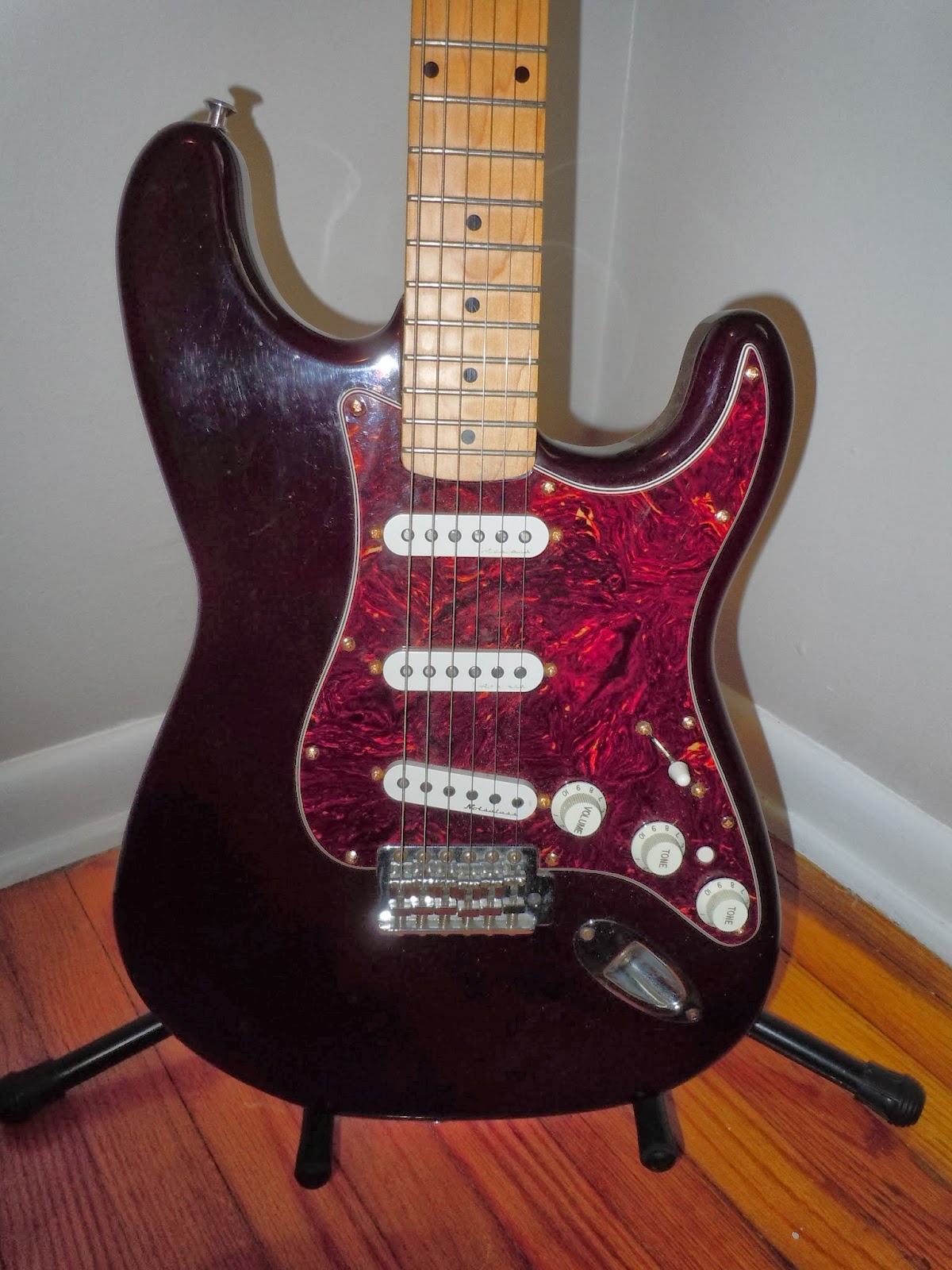
Yesterday, I found a unique Strat with a cool vintage vibe at the US Money Shops store in Fort Oglethorpe, GA. I believe it is supposed to be Daphne Blue-although to my eye it does closely resemble surf green. It has vintage reissue electronics and pickups that could be from a Squier CV50 or perhaps a 50's reissue Strat. The pickguard is the modern 11 screw style. The neck appears to be from a Squier or perhaps another aftermarket maple neck. It is equipped with jumbo frets and Kluson vintage style tuners. The tremolo bridge is the standard import model used on Squiers and cheaper Fenders. My operating theory at this point is that the body is one of the Daphne Blue Squier Bullet guitars. Its definitely a Franken-caster. I played this through a Fender tube amp at the shop and really dug the vintage vibe of the way it sounded. The price was reasonable too at $129.

This thing actually sounds fantastic. It has that edgy, gritty, vintage Fender Stratocaster tone that you would expect from a vintage reissue Strat. It seems to stay in tune and the intonation is decent right off the pawn shop wall.  I can easily see myself playing this guitar on stage. Check out the pictures-with vintage grime and fly specks still intact from the previous owner!


Getting ready to finish my custom Squier Strat

So, as those of you that have been following this blog know, in early 2013 I purchased a black early 90's vintage Squier Strat with a maple fingerboard from Craigslist for $100. This particular Strat was manufactured by Saehan and has a beautiful maple neck with the meaty vintage fretboard radius I love so much. I purchased this guitar specifically to modify with the loaded pickguard I acquired from local Chattanooga musician Terry Parker for $50. The pickguard came out of a Player's Strat and was complete with Vintage Noiseless pickups and a switch that engages the bridge pickup when any combination of the neck and middle pickups are selected-which is a very useful "tele-esque" sound. My goal was a guitar suitable for gigging on a budget.

Last year, I retrofitted the pickguard into the guitar and obtained some gold pickguard screws to match the gold screws holding the pickups and switch. My plan all along was to obtain some gold vintage Kluson tuners to replace the abysmal imported "trapezoid" tuners, a gold tremolo bridge, gold strap buttons and a gold "football" jack so everything would match. I am pleased to report that those items have now been ordered from Guitar Fetish and should arrive in the next few days! I look forward to getting everything installed and showing off my fully customized and killer sounding bargain guitar!

At this point I have $155 in the guitar and it looks as pictured below. The gold hardware items I ordered will add another $100-leaving me with a total price tag of $250 and a still killer sounding Strat with looks to match! Stay tuned for the updates!!!!
Korean Squier Strat with loaded pickguard fitted. 

Current "trapezoid" tuners. These are junk. 

Tuesday, April 30, 2013

Squier Vintage Modified Fretless Jazz Bass review

Squier Vintage Modified Fretless Jazz Bass


While at Guitar Center to find a case for my custom Squier P-Bass, I found the beauty pictured at left. This is a Squier Vintage Modified Fretless Jazz Bass. It was apparently traded in by someone who apparently did not play it much because it was in absolute mint condition. The original owner had the thing set up beautifully with high quality flat wound strings. The best part was the price...Guitar Center was asking a mere $159!!!!


Needless to say, I snapped this thing up and brought it home with me. I had been wanting a fretless bass to emulate the sound of an upright 'doghouse bass' for some older style music my band currently plays at our live shows.  I was also intrigued by the possibility of working in some melodic fretless solos as I become more comfortable with playing bass.

I should clarify that I'm a lifelong guitar player. I've moonlighted on bass a few times in my musical career but stepping up to be a full time bassist meant a tremendous commitment. Now that I've been working in this role about 5 months, I can honestly say that I have found my feet as a bass player and beginning to develop my own style and approach to the instrument.

Back to the fretless. This thing is an incredible value! If you purchase it new, you can expect to pay a very reasonable street price of $299. The fit and finish compares favorably to a MIM Fender. If you get one new from the factory, it comes with round wound strings. Throw those away and install a decent quality set of flat wounds for the right sound and feel.

Once strung with flat wounds, the neck on this thing plays beautifully. You can get a very convincing upright sound by using the neck pickup only and rolling off the tone. For that punchy 'Jaco' tone use only the bridge pickup and roll the tone off just a bit. I'm getting a very useful tone out of having the bridge pickup volume all the way up, the neck pickup volume at around 80-90% and the tone rolled off just slightly. This thing responds beautifully to wide and narrow finger vibrato and it is great fun to 'slide' around the fingerboard for that 'mwah' tone you can only get from a fretless.

I did notice some eq adjustment around 2-4 khz really helps smooth the sound of this instrument. Because it is a passive bass, some attention to dynamics while playing and some judicious compression is useful for getting the best sound through the PA. The pickups are Duncan Designed and represent a phenomenal value for money also. The noise level is exactly what you'd expect from any other typical single-coil Fender-present but in no way excessive. This is an interesting contrast to my stock Squier Affinity P-Bass which was extremely noisy prior to some modifications. Perhaps the limited run models get a bit more attention? I don't know.

I picked this up right before a gig. I took it to the gig, tuned it up, plugged it into a SansAmp DI and Hi-Z'd out into a 300 watt Ashdown amp as a monitor.  I played several songs during the show on this bass-including "Stormy Monday Blues," and "Fool For Your Stockings." When I switched to guitar my second guitarist played it on "Red House" and "Gimme Three Steps" as well. He gave it high marks. The bass player for the next band up was on hand for our set and he complimented the sound of this bass as well. I had to play consciously to ensure that I fingered the notes accurately...two millimeters off one way or another is very noticeable. The fret markers make this process easy and painless.

I highly recommend this bass. For $300 new you simply can't beat it! I paid $159 for my gently used one set up with good quality flat wounds...so for me it was an even better bargain! If a fretless bass is on your wish list, this thing compares favorably with basses priced at $500-$600 easily. You won't find Jaco tone any cheaper!!!!


Tuesday, April 16, 2013

'97 Squier with '05 Player Strat electronics

After purchasing my '97 Squier Standard Strat to use with my Player's Strat electronics, I was ready to put everything together.

I removed the existing Squier pickguard with the all pickups and electronics still on the pick guard. I broke out the soldering iron and installed the brown pearloid pick guard with Vintage Noiseless pickups I purchased that came from a Fender Player's Strat. The pick guard aligned fine with the neck and the pickup pole pieces aligned beautifully with the strings. I did have to drill some new holes for pick guard screws as those did not line up exactly.

Since the Fender Players Strat had gold hardware, the pickup screws on my new pick guard are gold. I ordered some gold pick guard screws from eBay user guitar_hero2012 for a mere $2.50 US with shipping included. The shipment originated in Fanling, Hong Kong and took about 3 weeks to be delivered...but I have no complaints! These were exactly as advertised and matched beautifully.


All of the other hardware on this Squier is still the standard chrome. Since my plan over time is to replace the tuners, bridge and cable jack anyway, I am planning to order these in gold to match the guitar.

This is the guitar as it looks now. I will post a link to some YouTube video of how it sounds soon and will continue updating as I make further upgrades.


Sunday, April 14, 2013

My first project-A 1997 Squier Stratocaster

This craziness all started with a couple of Craigslist purchases. Isn't that always the way?

First I responded to a Craigslist ad for a brown pearloid loaded Stratocaster pickguard with all electronics and Vintage Noiseless pickups still attached. It was advertised for $75.  I called the number in the craigslist ad and it turned out to be someone I knew-Terry Parker of the great local band Southlander! Check them out sometime-they are a truly great group! http://www.reverbnation.com/southlander After some friendly catching up, Terry made me a great deal and sold me the pickguard with electronics for $50. My intention was to use the pickups in another guitar I had laying around.

Fender Player's Strat. I purchased this exact pickguard and electronics from Terry Parker for $50!


After getting the pickguard home, I decided it would be a real shame to tear it apart. I decided it would make more sense to find a cheap Strat and assemble a "Partscaster."

Squier headstock w/ 'Spaghetti' logo. 
While perusing Craigslist again, I happened upon a black 1997 Squier Strat with a gorgeous maple fingerboard. This particular model had the "Spaghetti" logo on the headstock so I knew it was one of the better quality Squiers-probably a 'Squier Standard'. This seemed like a good place to start to make an inexpensive guitar for gigging. I met the young man who owned it in Fort Oglethorpe, tested the guitar and paid him the asking price of $100.

Squier as purchased

Upon getting the guitar home I did some research, it turned out my Craigslist find was a Korean Squier Strat with a KV serial number made by Saehan. From 1996-1998 Saehan turned out Squiers that were known for better-than-average bodies and gorgeous maple necks with the meaty 'vintage' radius that I prefer.
At this point I realized I had what I needed to make a great sounding guitar...for an initial $150 investment!! Stay tuned as I put them together!


Wednesday, April 10, 2013

Please allow me to introduce myself.....

Please allow me to introduce myself. My name is Adrian Coker, or Ace to my long time friends. I am a resident of the Chattanooga, TN/GA metro area and a working musician. I've played guitar since I was 11 years old. I am currently working as the bass player in a 5 piece Blues and Classic Rock cover band-Code Blue.

Like every other working musician, I want gear that gives me the sounds I'm looking for. More importantly, I need gear that works and is durable. I am a long time devotee of Fender guitars and basses, having owned many genuine Fender instruments-vintage, old and new.

For years, Fender has been the gold standard in instruments for working musicians.The simplicity and durability of Leo Fender's designs have stood the test of time. For most of my life you could purchase an American Standard or American re-issue Fender guitar or bass for a reasonable amount of money and be assured of a professional level of fit, finish and sound.

Unfortunately, those glory days have come to an end. While the fit, finish and sound quality of American Standard instruments remains indisputably uniformly high, the price has soared in recent years-effectively pricing me and lots of other working musicians out of the market. Even the Made-In-Mexico Road Worn and Vintage reissue series guitars are now close to $1000 street price and no longer represent a bargain for the working musician.

Since they began, the Asian manufacturers have been improving their quality control. These manufacturers, such as FujiJen, Tokai, Dyna, (Japan) Samick, Saehan, Cort, (Korea) Yako, (Taiwan) AXL, (China) and Cor-Tek (Indonesia) All of the above are capable of producing quality guitar bodies and necks in their factories, and over the years their guitars have been sold under multiple brand names-Including Squier.

In 1982, Fender decided to launch lower cost versions of their venerable Stratocaster (R), Telecaster and Precision Bass designs under the Squier nameplate. This was to counteract Japanese copies being made by Greco and Tokai that were excellent guitars and significantly cheaper than Fender's US made guitars. These early "JV" Squiers were made in Japan by FujiJen Gakki and are highly collectible today due to their high quality. From this beginning, Squier guitars have continued to be manufactured and many models have been made over the years with greatly variable results.

For most guitarists and bassists I know the Squier name is in their view synonymous with "crap." In defense of these folks, Squier has done much over the years to reinforce this view with several substandard iterations of various models-especially Strats. They've also made some instruments that were a great value and usable for gigging with minor modifications. Personally, I advocate evaluating an instrument solely on its merits and not dismissing something simply on the grounds it doesn't have the right headstock decal.

Squier's latest notable achievement is the "Classic Vibe" and "Vintage Modified" series of instruments. Since 2008, these reasonably priced ( under $400) guitars and basses have given players that like vintage Fender styling, hardware and sounds a viable option in my humble opinion.

I've made an executive decision that as I collect guitars and basses, I am going to identify and purchase  Squier instruments almost exclusively and share my experiences with obtaining, playing and modifying these instruments. My goal is to keep costs down while obtaining fun and giggable instruments. Fasten your seat belts kids...this is going to be an interesting ride!!!